The best time to aerate and overseed your lawn is early fall for cool-season grasses (late August through October) and late spring for warm-season grasses (May through June). Timing matters more than technique - get the window wrong and you waste seed, labor, and water.
Lawn aeration and overseeding work together as a system. Aeration punches holes through compacted soil and thatch, and overseeding drops fresh grass seed directly into those openings where soil contact is guaranteed. Done at the right moment in the growing calendar, this combination fills in thin patches, thickens overall turf density, and crowds out weeds before they establish. Done at the wrong moment, it's an expensive experiment that mostly feeds birds.
Here's exactly when to do it, why the timing works biologically, and how to execute the process from first pass to first mow.
Why Timing Is Everything
Grass seed needs three things to germinate reliably: consistent soil moisture, soil temperatures in the right range, and enough growing days before stress sets in. Each grass type has a different biological clock, and your aeration-overseeding schedule has to match it.
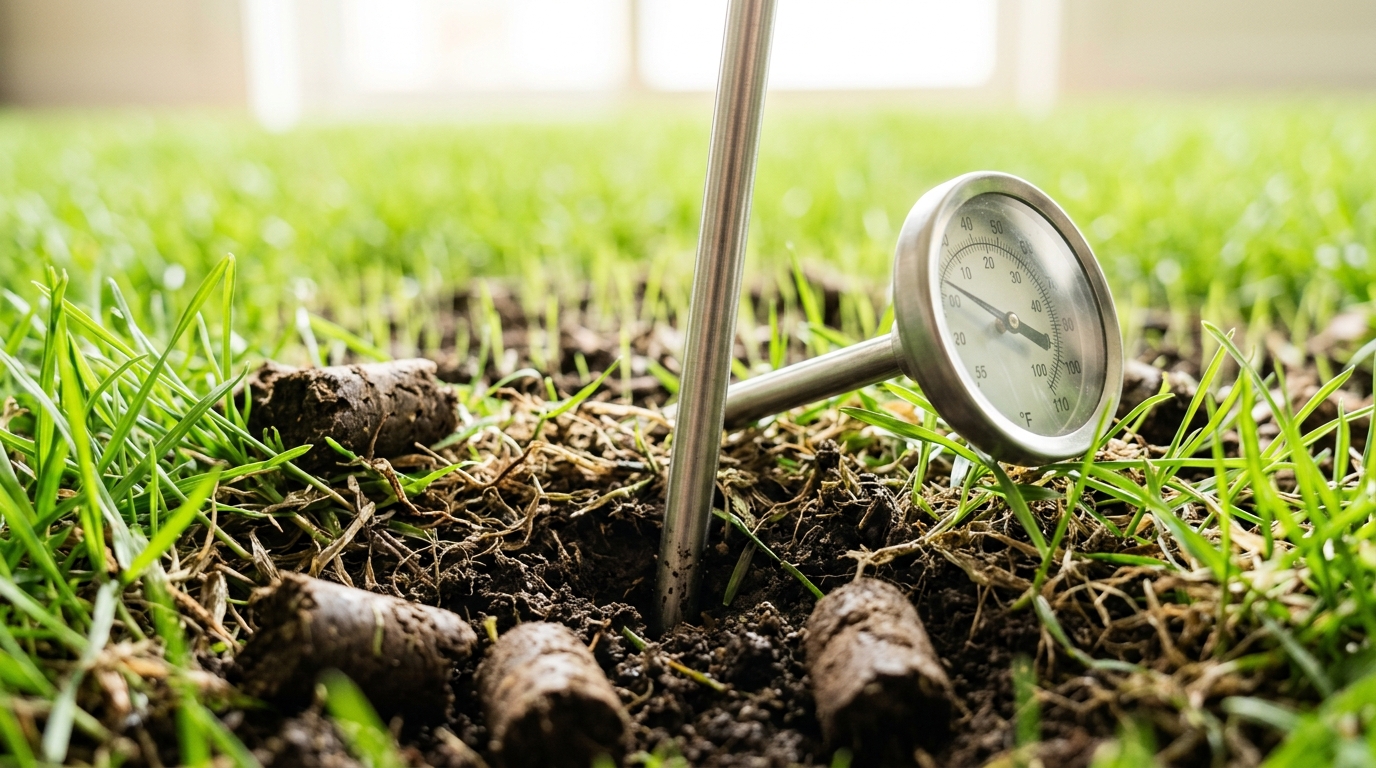
Soil temperature - not air temperature - is the controlling variable. Grass seed doesn't respond to the thermometer on your porch; it responds to warmth at the root zone. Cool-season grasses germinate best when soil temperatures sit between 50°F and 65°F. Warm-season grasses need soil temperatures above 65°F, ideally between 70°F and 80°F, to germinate reliably.
You can check soil temperature with an inexpensive probe thermometer, or use your state's cooperative extension soil temperature map if one is available. Most are updated weekly during the growing season.
Cool-Season Grasses: Late Summer to Early Fall Is the Target Window
Cool-season grasses - Kentucky bluegrass, tall fescue, fine fescue, and perennial ryegrass - thrive in the northern two-thirds of the United States and in higher-elevation areas of the South. Their ideal aeration and overseeding window runs from late August through mid-October, depending on your specific location.
Here's why fall wins for cool-season lawns:
- Soil temperatures are still warm from summer, which accelerates germination to 7–14 days for most varieties.
- Air temperatures are cooling, which reduces heat stress on tender new seedlings.
- Weed pressure drops sharply in fall. Crabgrass and most broadleaf annual weeds are finishing their life cycle, so new grass seedlings face far less competition.
- Moisture is more consistent. Fall rain patterns in most northern regions reduce the irrigation burden on new seed.
- New seedlings get a full fall growing season plus early spring before facing summer heat, giving roots time to establish deeply.
The hard deadline for cool-season overseeding is roughly 45 days before your first expected hard frost. Seed needs that buffer to germinate and develop enough root mass to survive winter. Planting after mid-October in Zone 5 or Zone 6 is a gamble. Planting after early October in Zone 4 is likely wasted effort.
Spring overseeding for cool-season grasses is a secondary option, not a first choice. Spring-seeded cool-season grass faces crabgrass competition as temperatures climb, and the new seedlings often don't have enough establishment time before summer heat stress arrives. If you must overseed in spring, target April - the earlier the better.
Warm-Season Grasses: Late Spring Is the Sweet Spot
Warm-season grasses - Bermuda, zoysia, centipede, St. Augustine, and bahia - dominate lawns in the South, Southeast, and parts of the Southwest. These grasses go dormant in cool weather, so fall aeration and overseeding is the wrong call entirely for this category.
Aerate and overseed warm-season lawns when:
- Soil temperatures have reached and stabilized above 65°F (usually May through June in most southern states).
- The last frost date has passed by at least 2–3 weeks.
- The grass has fully broken dormancy and is actively growing.
Aerating too early in spring - while warm-season grass is still dormant - stresses the turf without the recovery benefit. Wait until the lawn has greened up by at least 50% before running a core aerator over it.
Cool-Season vs. Warm-Season Timing: A Direct Comparison
Factor
Cool-Season Grasses
Warm-Season Grasses
Best window
Late Aug – mid-Oct
May – June
Ideal soil temp
50°F – 65°F
65°F – 80°F
Germination time
7–21 days (variety-dependent)
10–30 days (variety-dependent)
Primary competitor weed
Crabgrass (declining in fall)
Nutsedge, summer annuals
Avoid aerating during
Summer peak heat (July–Aug)
Dormancy (Nov–Mar)
Secondary window
Early spring (April)
Late summer (Aug) - aeration only
How to Execute Aeration and Overseeding Correctly
Timing gets you to the starting line. Execution determines whether the investment pays off.
- Mow short before you start. Drop your mowing height to about 2 inches the week before aerating. This improves core penetration and gives seed better access to soil.
- Water deeply 1–2 days before aeration. The soil should be moist 4–6 inches down but not muddy. Dry, hard soil defeats the aerator; wet soil clogs the tines.
- Use a core aerator, not a spike aerator. Core aerators remove plugs of soil. Spike aerators just push soil sideways and can worsen compaction over time. Rent a drum-style core aerator from a local equipment company if you don't own one - a standard 48-inch drum machine handles most residential lawns in 1–2 hours.
- Make two passes at perpendicular angles. One pass north-to-south, one pass east-to-west. You want cores every 3–4 inches across the lawn's surface.
- Leave the cores on the lawn. They break down within 2–3 weeks and return organic matter to the soil. Don't rake them up.
- Overseed immediately after aerating. Use a broadcast spreader for open areas and a drop spreader along edges. Seed rate varies - Kentucky bluegrass at 2–3 lbs per 1,000 sq ft for overseeding; tall fescue at 4–6 lbs per 1,000 sq ft.
- Topdress with a thin layer of compost. A ¼-inch layer of fine compost over seeded areas improves moisture retention and seed-to-soil contact dramatically. This step alone measurably improves germination rates.
- Water lightly and frequently until germination. Keep the top inch of soil consistently moist - that means light watering 2–3 times daily for the first 2 weeks. Once seedlings reach 1 inch, transition to deeper, less frequent watering.
- Hold off on the first mow until new seedlings reach 3–4 inches. Mow high (3 to 3.5 inches) for the first two cuts to avoid uprooting shallow roots.
Common Mistakes That Ruin the Results
- Applying pre-emergent herbicide within 8 weeks of overseeding. Pre-emergents prevent all seed germination, including your new grass. Skip the fall pre-emergent application if you're overseeding.
- Overseeding without aerating. Seed dropped onto thatch-heavy turf rarely makes soil contact. Germination rates drop significantly without the aeration step.
- Waiting too late in the season. Enthusiasm in mid-November does not override biology. Seed planted without enough time to germinate and harden off before frost is wasted.
- Using old seed. Grass seed loses viability quickly. Seed stored for more than one season often has germination rates well below the label claim. Buy fresh seed each year.
How Often Should You Aerate?
Most lawns benefit from aeration once per year. High-traffic lawns - yards with kids, dogs, or heavy foot traffic - can tolerate twice-yearly aeration without harm. Sandy soils compact less than clay-heavy soils, so if your soil drains well and doesn't show surface hardening, every other year is sufficient for aeration-only maintenance. Overseeding frequency depends on your lawn's density - thin, patchy turf should be overseeded annually until density is restored.
Can I aerate and overseed in the same weekend?
Yes - and you should. Aerating and overseeding on the same day or within 24 hours maximizes seed-to-soil contact. The cores pulled during aeration create ideal pockets for seed to settle into. Waiting more than 48 hours after aerating before overseeding reduces that advantage as cores begin to dry out.
Do I need to dethatch before aerating?
Only if your thatch layer exceeds ¾ inch. Measure thatch depth by cutting a small plug from your lawn with a shovel - the spongy, brown layer between the green grass and soil is thatch. At ¾ inch or more, dethatch first, then aerate, then overseed. For most lawns, annual core aeration gradually reduces thatch on its own without a separate dethatching step.
What if I have a mix of shade and sun areas in my lawn?
Use a different seed blend for shaded zones. Fine fescue varieties (creeping red fescue, chewings fescue) tolerate shade significantly better than Kentucky bluegrass or tall fescue. Many homeowners use a sun/shade blend for convenience, but results are better when you match seed variety to actual light conditions. Overseed shaded areas slightly heavier - at 125% of the standard rate - to compensate for slower germination in low light.
Should I fertilize after overseeding?
Apply a starter fertilizer at the time of overseeding, not your regular lawn fertilizer. Starter fertilizers are high in phosphorus (look for a middle number of 18–24 on the label, such as a 12-24-8 analysis), which directly supports root development in new seedlings. Avoid high-nitrogen fertilizers immediately after overseeding - the nitrogen push favors the existing grass at the expense of seedling establishment.
Is it worth hiring a professional service for aeration and overseeding?
For lawns under 5,000 square feet, DIY aeration with a rented core aerator is cost-effective and manageable in an afternoon. For larger properties or lawns with severe compaction, slope, or difficult access, professional lawn care services bring commercial-grade equipment that covers ground faster and more consistently. The decision usually comes down to time, not cost - equipment rental plus seed and compost runs $150–$350 for a typical residential lawn, while professional services generally quote $300–$700 for the same square footage depending on your market and region.