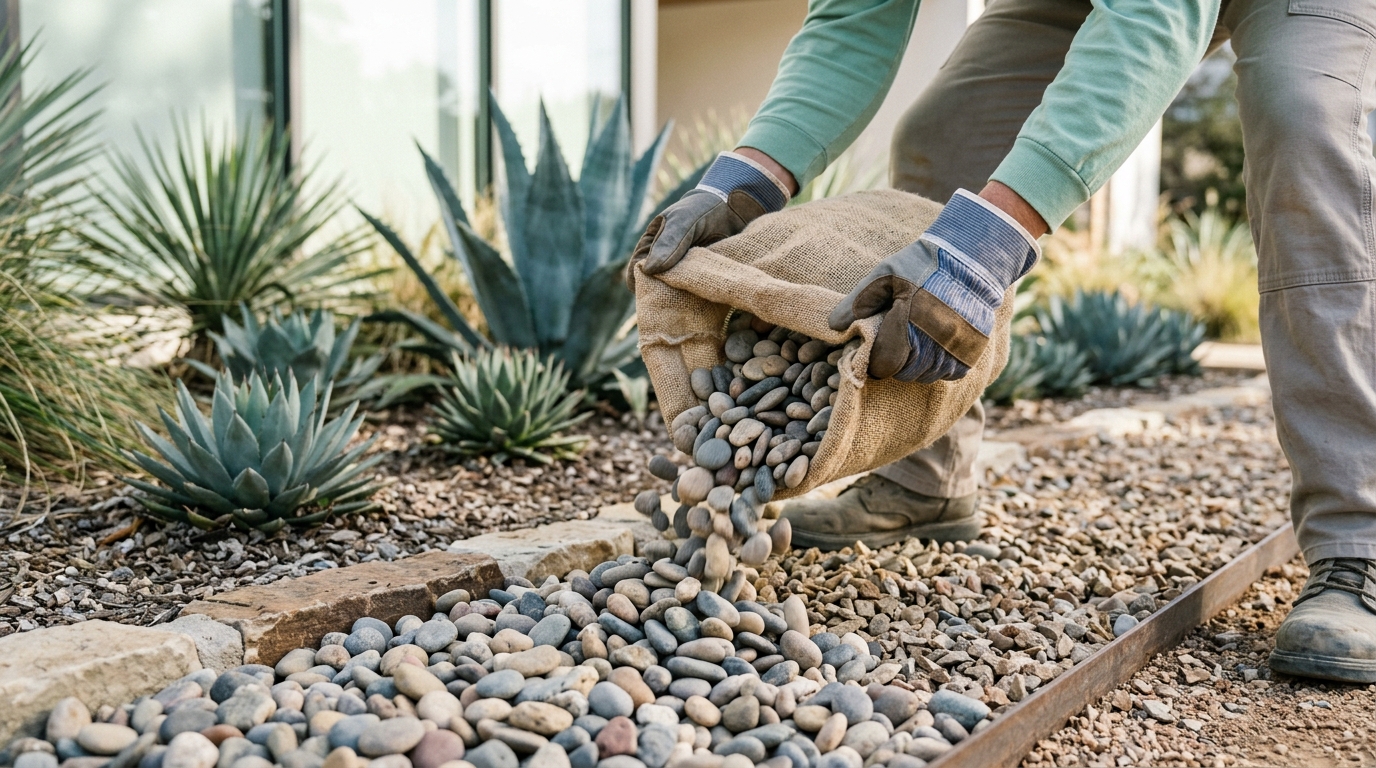
Mulch wins for garden beds and tree rings where soil health matters; rock wins for low-water landscapes, drainage areas, and permanent paths where you never want to redo the work. The right choice depends on your climate, plant types, maintenance tolerance, and budget - and most yards benefit from using both strategically.
Ground cover is one of those deceptively simple landscaping decisions that shapes how your yard looks, how your plants perform, and how many Saturday mornings you spend on maintenance for the next decade. Let's break it down by what actually matters.
What Mulch Does Well
Organic mulch - shredded hardwood, cedar, pine bark, straw, or wood chips - works as a living amendment for your soil. As it breaks down, it feeds soil microbes, improves drainage in clay soils, increases water retention in sandy soils, and gradually lowers soil pH in a way that most flowering plants and shrubs appreciate.
- Moisture retention: A 3-inch mulch layer reduces soil moisture evaporation by 25–50%, cutting irrigation needs significantly during dry months.
- Soil temperature regulation: Mulch buffers root zones against temperature swings - up to 10°F cooler in summer, measurably warmer in winter.
- Weed suppression: A proper 2–4 inch layer blocks 70–90% of annual weed germination by blocking sunlight.
- Soil health: Decomposing organic mulch adds humus, feeds earthworms, and supports beneficial fungal networks that help plants absorb nutrients.
- Plant compatibility: Most perennials, annuals, shrubs, and trees thrive in mulched beds.
The trade-off is maintenance. Organic mulch breaks down - that's the point - so you refresh it every 1–3 years depending on material. Hardwood mulch lasts longer than straw. Cedar is naturally pest-resistant and breaks down slower than pine. Budget roughly $3–$7 per bag for bagged mulch, or significantly less per cubic yard if you order in bulk from a local landscape supplier.
What Rock Does Well
Decorative rock - pea gravel, river rock, crushed granite, lava rock, or decomposed granite - is a permanent installation. You put it down once, and barring a major redesign, it stays. That permanence is rock's greatest selling point and its biggest limitation.
- Longevity: Rock doesn't decompose. A well-installed rock bed with landscape fabric underneath lasts 10–20+ years with minimal intervention.
- Fire resistance: In wildfire-prone regions, rock is a critical defensible-space material. It doesn't ignite the way organic mulch does.
- Drainage zones: Rock excels around foundations, downspouts, and slopes where standing water is a problem.
- Desert and xeriscape gardens: Rock pairs naturally with succulents, ornamental grasses, agave, and drought-tolerant native plants that don't want rich, moist soil.
- Pest resistance: Rock doesn't harbor termites, fungus gnats, or the moisture-loving pests that sometimes colonize wood mulch piles.
Rock's downside is thermal load. Light-colored rock reflects heat, but dark rock - and especially decomposed granite - absorbs and radiates heat. In hot climates, rock beds adjacent to buildings or plant beds can create a heat sink that stresses plants and raises cooling costs. Rock also doesn't improve soil. Plants sitting in rock-covered ground still need whatever soil quality was there when you started.
Side-by-Side Comparison: Mulch vs. Rock
Factor
Organic Mulch
Decorative Rock
Upfront cost
Low to moderate
Moderate to high
Long-term cost
Recurring (refresh every 1–3 years)
Near zero after install
Soil health benefit
High - adds organic matter
None
Weed suppression
Good with proper depth
Good with fabric; weeds can root in debris over time
Moisture retention
Excellent
Poor to moderate
Heat management
Insulates and cools
Can increase heat load
Fire safety
Flammable
Non-combustible
Best plant types
Perennials, shrubs, trees, annuals
Succulents, ornamental grasses, natives
Aesthetics
Natural, soft look; fades over time
Clean, modern, or rustic; color-stable
Removal/flexibility
Easy to change
Labor-intensive to remove
Climate Is the Deciding Factor
In humid climates - the Southeast, Pacific Northwest, or Midwest - organic mulch is usually the stronger default. Plants need moisture management, soil biology is active and responsive to amendments, and the mild temperatures mean wood mulch doesn't become a fire hazard.
In arid climates - the Desert Southwest, Southern California, parts of the Mountain West - rock often makes more practical sense. Water conservation matters more than soil amendment, and drought-adapted plants don't want the extra moisture and fungal activity that decomposing mulch creates. Wildfire risk is another non-negotiable reason to prioritize rock in fire-prone zones.
In transitional climates, the smart move is zoning: use mulch in shade gardens, established tree rings, and flowering perennial beds; use rock in sunny pathways, around the foundation, and in any area with drainage challenges.
Installation Tips That Make Either Choice Work Better
Regardless of which material you choose, installation quality determines results.
- Clear weeds before you start. Neither mulch nor rock kills established weed roots. Pull, smother, or treat weeds before laying any cover material.
- Use the right depth. Mulch needs 2–4 inches - less doesn't suppress weeds, more risks smothering roots and creating nitrogen drawdown. Rock needs 2–3 inches for coverage and weed suppression.
- Keep mulch away from trunks and stems. "Mulch volcanoes" piled against tree trunks cause rot and pest damage. Leave a 2–3 inch gap around any woody stem.
- Use landscape fabric under rock, not under mulch. Fabric under organic mulch traps decomposition byproducts, suffocates soil life, and becomes a nightmare to remove later. Under rock, quality woven fabric genuinely reduces long-term weed pressure.
- Edge your beds cleanly. A steel or aluminum edging strip keeps rock from migrating into lawn and keeps mulch from washing out during rain events.
Cost Reality Check
Rock costs more upfront. A cubic yard of pea gravel runs roughly $40–$80 delivered, and river rock can reach $100–$150 per cubic yard or more depending on size and region. Installing rock yourself is feasible, but the weight makes large projects genuinely labor-intensive.
Bulk hardwood mulch runs $25–$50 per cubic yard delivered in most markets, and one cubic yard covers approximately 100 square feet at 3 inches deep. A medium-sized yard with 500 square feet of beds uses about 5 yards - call it $125–$250 for mulch vs. $200–$500+ for equivalent rock coverage. But factor in the mulch refresh cost every 1–2 years, and the lifetime cost difference narrows substantially within a decade.
The Hybrid Approach Most Landscapers Actually Use
Professional landscapers rarely choose one material for an entire property. The standard approach: mulch in planted beds where soil health and moisture matter, rock along foundations and drainage routes, decomposed granite on paths and driveways, and potentially lava rock in any succulent or cactus feature. This isn't indecision - it's matching material to function, which is exactly what good landscape design does.
---
How often do you need to replace mulch?
Most organic mulches need refreshing every 1–3 years. Shredded hardwood and cedar last closer to 2–3 years. Pine bark and straw break down in 1–2 years. You don't always need a full replacement - adding 1–2 inches on top of existing decomposed mulch is sufficient in most cases.
Does rock actually prevent weeds?
Rock with a quality woven landscape fabric underneath suppresses weeds effectively for several years. Over time, organic debris accumulates in the rock layer and creates a seedbed for weeds. Blowing out debris annually with a leaf blower significantly extends weed suppression. Without fabric, rock alone slows weeds but doesn't stop them.
Is mulch a fire risk near my house?
Yes - organic mulch is combustible, and fire safety guidelines in wildfire-prone regions recommend keeping mulch at least 5 feet from structures and using rock or hardscape within that buffer zone. Rubber mulch, despite being marketed otherwise, is also flammable. In high fire-risk areas, use decomposed granite, crushed stone, or concrete near foundations.
Which ground cover is better for sloped areas?
Shredded or chipped bark mulch holds on gentle slopes better than nugget-style mulch, which rolls. On steeper slopes, rock - particularly angular crushed stone rather than smooth river rock - grips better and doesn't wash downhill. For any slope over 30 degrees, combine ground cover with erosion-control netting or planted ground cover plants for structural stability.
Can you switch from rock to mulch if you change your mind?
You can, but it's work. Rock needs to be raked out and hauled away - roughly a ton of material per 100 square feet at 2 inches deep. Landscape fabric removal is another step. Budget for a half-day of labor or a dumpster rental for large areas. Switching from mulch to rock is easier since decomposed mulch can be tilled into the soil as an amendment before rock goes down.